
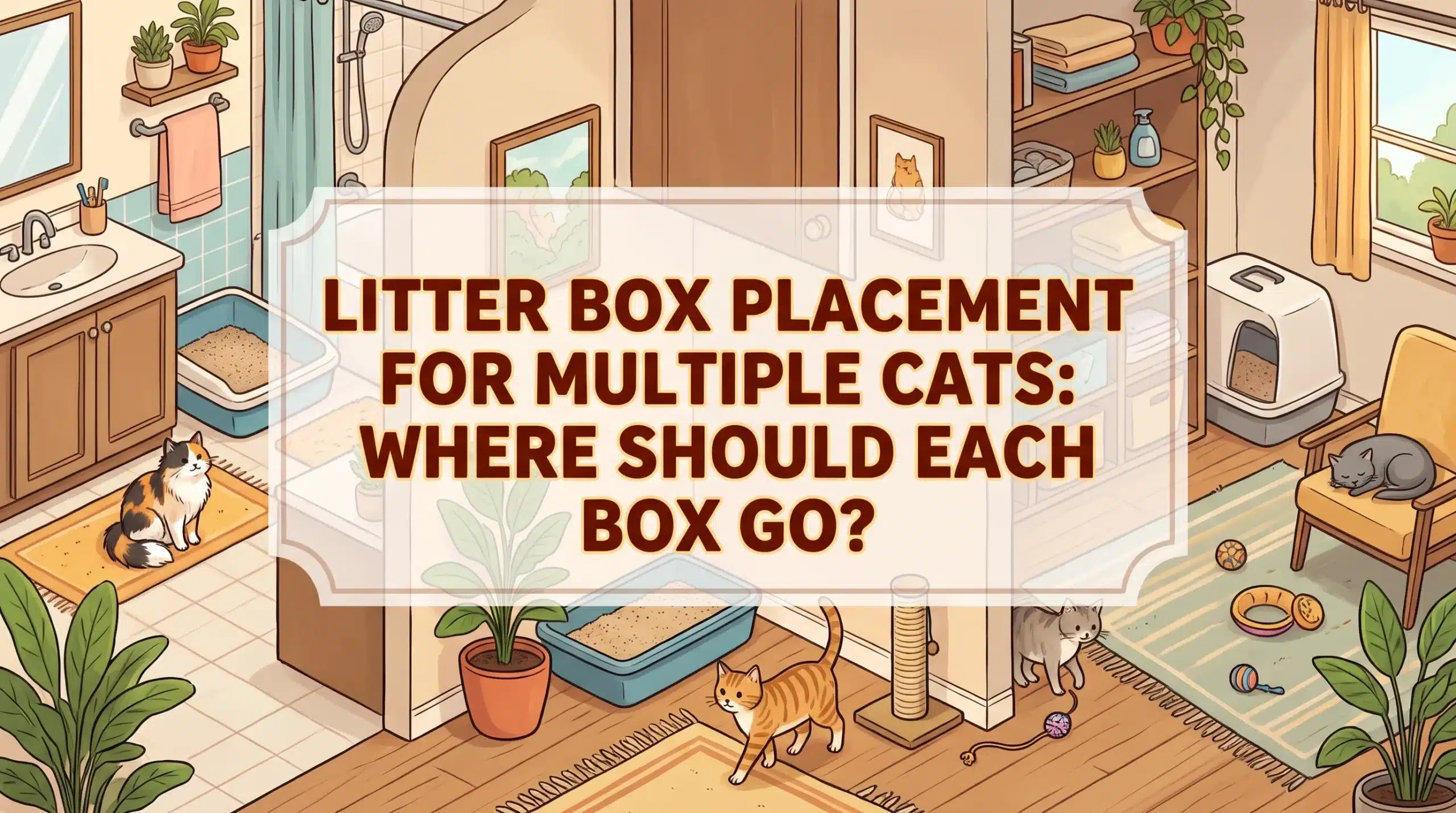
Cats rarely appreciate bathroom queues, especially when another cat appoints itself the surprise inspector. Three litter boxes lined up in one corner offer extra capacity, but they may still function as one bathroom location: a single cat can guard the approach to all three.
For litter box placement in multiple-cat homes, ask: Can every cat reach and leave a suitable box without being startled, trapped, or challenged? Ohio State University’s Indoor Pet Initiative recommends distributing boxes in accessible locations, rather than concentrating them in one spot.
Key Highlights: Spread the Boxes Out and Keep Routes Open
Use one box per cat, plus one extra as a starting guideline, not a guarantee that the count alone will solve access problems.
-
Spread boxes among separate, quiet locations.
-
Provide a box on each floor cats regularly use.
-
Keep approaches clear and allow cats to see what is coming.
-
Separate toileting areas from food and water.
-
Avoid startling appliances and doors that can accidentally shut.
International Cat Care’s litter tray guidance supports providing multiple, suitably located trays. A spare box behind a closed door is not much of a spare.
Where Should Each Box Go?
Evaluate rooms by reliable access, noise, and opportunities for another cat to block the route. These are practical considerations, not experimentally established rankings of cats’ favorite rooms.
|
Candidate location |
When it works |
What can go wrong |
Placement adjustment |
|---|---|---|---|
|
Bathroom |
The door stays open and household activity is modest. |
A closed door removes access; another cat can guard the doorway. |
Secure the door open and keep the approach clear. |
|
Quiet bedroom or home office |
The room is consistently accessible and within the cat’s comfortable area. |
A corner creates a dead end, or access crosses another cat’s guarded resting spot. |
Choose an open position with visibility and room to leave. |
|
Laundry room |
Cats remain comfortable around the appliances. |
Sudden spin cycles or dryer noise can startle a toileting cat. |
Use another room if appliance noise causes hesitation or avoidance. |
|
Hallway or landing |
The space is broad, quiet, and easy to approach. |
Narrow passages become bottlenecks; foot traffic interrupts use. |
Place the box outside the main walking line without narrowing access. |
|
Basement or upper floor |
Cats comfortably use the stairs and spend time there. |
Stairs discourage or prevent access, especially with pain or limited mobility. |
Keep another box on the cat’s usual living floor. |
|
Closet or furniture enclosure |
Access stays open and the interior is spacious and easy to clean. |
A single entrance, cramped interior, or closing door creates an unreliable dead end. |
Prefer an open setup if the enclosure restricts movement or visibility. |
Cats Protection and Blue Cross provide guidance on quiet locations, accessibility, tray design, and keeping toilets separate from feeding areas.
Match the Layout to Your Cats
For two cats, start with three boxes in three separated locations. In a single-story home, that might mean an accessible bathroom, a quiet office, and a bedroom away from feeding areas. Three boxes beside the washing machine do not offer equivalent choices if one cat controls the laundry-room entrance.
In a multistory home, distribute boxes across the floors cats actually occupy. Keep a nearby option for kittens, older cats, and cats with mobility limitations rather than requiring every bathroom visit to include stairs. VCA’s litter box guidance discusses how accessibility, preferences, and medical problems can affect use.
In a small apartment, use the most separated practical locations. There is no universal minimum distance that makes boxes independent. Different rooms can help, but a clear approach matters more than an arbitrary measurement. Avoid squeezing every box into one hidden nook simply because it looks tidier.
For cats that avoid one another, place options within each cat’s comfortable area. A timid cat should not have to pass the household hallway monitor to reach every toilet. The Merck Veterinary Manual identifies social conflict and environmental factors among contributors to feline behavior problems.
Watch for the Bathroom Bouncer
Conflict can be quieter than a fight. Look for:
-
Staring or waiting near a box’s approach.
-
Blocking doorways or narrow passages.
-
Chasing another cat after it toilets.
-
Hesitating, scanning repeatedly, or retreating before entering.
-
Consistently avoiding one location.
These observations suggest a placement problem worth investigating, but they do not establish the cause by themselves.
Add a box in a safer location before removing a familiar option. Observe whether the hesitant cat uses it and whether approaching and leaving appear more relaxed. Change one feature at a time when practical so you can identify what helps.
Placement cannot compensate for dirty boxes, cramped dimensions, or litter a cat dislikes. The ASPCA’s litter box troubleshooting guidance addresses aversion, household stress, and preferences alongside location.
Do not punish accidents or label them spite. New house-soiling warrants veterinary assessment because pain, disease, and environmental difficulties can overlap, as Cornell’s house-soiling guidance explains.
Straining, repeated attempts with little or no urine, or apparent inability to urinate require immediate veterinary attention, especially in male cats. Urinary obstruction is an emergency, not a furniture-arranging problem. See Cornell’s urinary tract disease guidance.
Final Thoughts: Check the Weakest Route
Trace each cat’s path from its usual resting place to a box. Note closed doors, stairs, noisy appliances, narrow approaches, and places where another cat could wait unseen. Check the exit route too.
Fix the weakest route first, then watch how the cat responds. Moving an accent table may be more useful than buying a fourth box for the same crowded corner.
FAQ
Can two cats share a litter box?
Yes, cats may use the same box. That does not remove the need for multiple accessible options, especially when one is dirty, occupied, or blocked.
Do boxes beside each other count separately?
They provide separate containers and extra capacity, but not the access advantages of separate locations. One guarded approach can make both unavailable.
Does every floor need a litter box?
Provide one on each floor cats regularly occupy. Nearby access is especially important for kittens, older cats, and cats with mobility limitations.
Can I put a box near food and water?
Choose separate areas whenever possible. There is no universal minimum distance; avoid placing the toilet directly beside feeding or drinking stations.
Should I move a box after an accident?
First consider medical causes, cleanliness, and access problems. Adding a suitable option may be less disruptive than abruptly relocating the familiar box. VCA’s house-soiling guidance explains why assessment should address both medical and environmental contributors.

In her previous life, Lisa traveled extensively, both for work and leisure. After the pandemic struck, Lisa locked up her luggage and adopted a cat ever since.
Lisa is now an avid cat lover, she devotes most of her free time serving as butler to her adorable feline at home. When she is not with her cat, she can be seen using her phone sourcing for the latest cat supplies online.